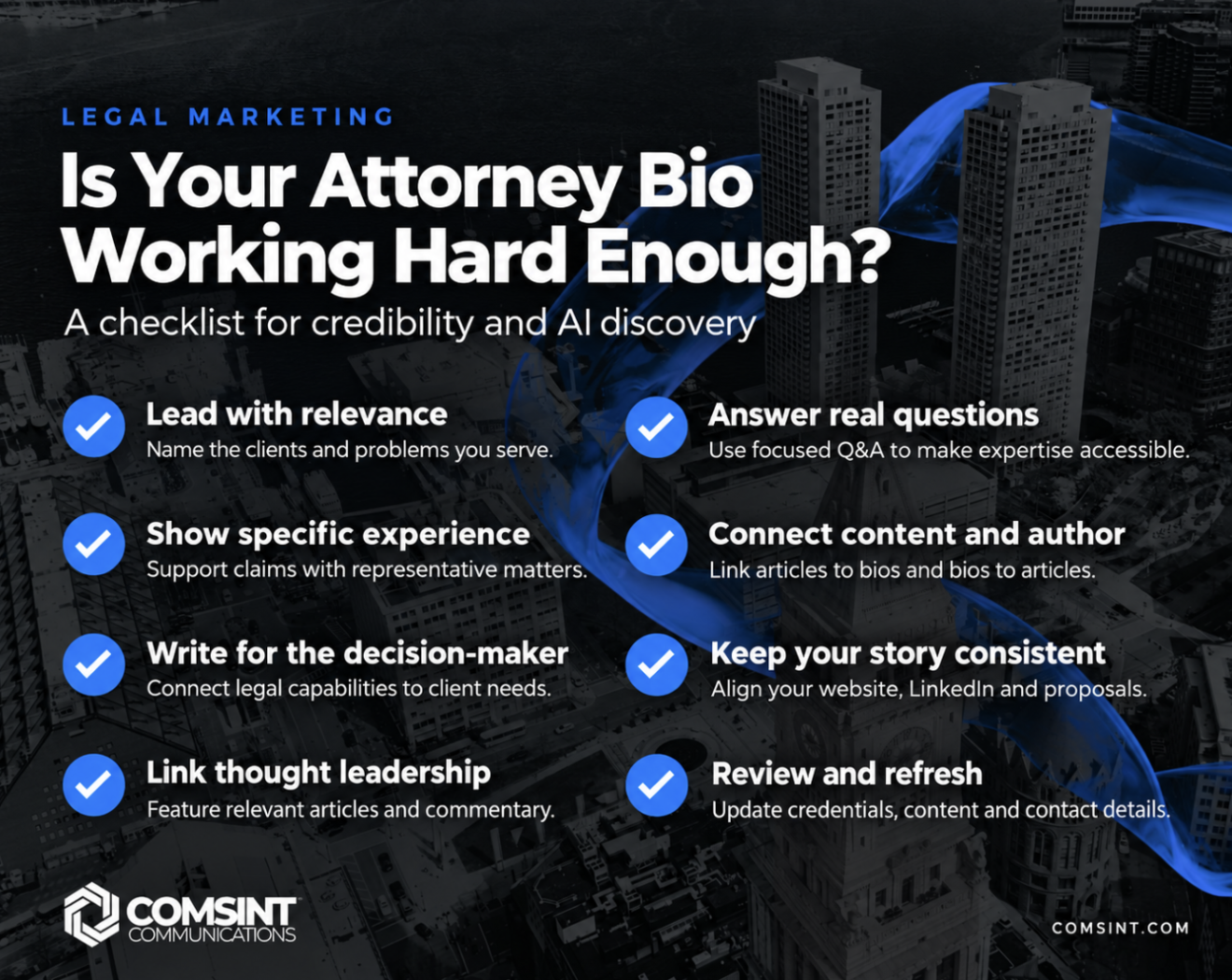
An attorney biography should help a prospective client make a decision. Yet many law firm bios open with a title, describe a broad practice and move quickly into education, memberships and awards. Readers learn where the lawyer has been, but may finish without understanding why that experience matters to their problem.
A stronger bio makes that connection explicit. It explains who the attorney represents, the circumstances in which clients seek their help and the experience that supports hiring them. As large language models increasingly become another way people search for information, firms also need to consider how clearly their biographies communicate that expertise to systems retrieving and synthesizing website content.
Great Jakes’ articles on attorney bios emphasize focused positioning and the evolution of the biography into a fuller platform for demonstrating expertise. Those are useful starting points. The challenge for firms is translating that approach into content that supports business development and remains manageable for busy attorneys.
Lead with the client’s problem
The opening paragraph should establish relevance before asking readers to work through credentials. A managing partner title may matter, but it does not explain whether the lawyer understands a hospital acquisition, a closely held business dispute or a contested estate.
Consider this hypothetical opening:
“Jane Smith is a partner in the firm’s litigation department. She represents clients in complex commercial disputes in state and federal courts.”
Now consider a more specific version:
“Jane Smith represents owners of closely held businesses in disputes over control, succession and the departure of a business partner. Her practice includes shareholder litigation and negotiated resolutions when a disagreement threatens the company’s operations.”
The second version gives prospective clients a recognizable situation. It also gives referral sources language they can use to explain why Jane might be the right person to call.
Specificity must reflect the attorney’s actual practice. A lawyer with several substantial areas of experience can organize those areas clearly and give each enough supporting detail to establish relevance. The objective is to make the practice understandable without narrowing it artificially.
Write for the person making the hiring decision
Attorneys often describe their work in language familiar to other attorneys. That can be appropriate when the audience is sophisticated in-house counsel. It can become a barrier when the reader is a business owner, an HR executive or someone confronting a legal issue for the first time.
Connect legal terminology to a practical situation. A bio can mention restrictive covenants while explaining that the attorney advises employers when departing employees take confidential information or join competitors. A healthcare lawyer can identify regulatory experience while describing how it applies to a planned affiliation or expansion.
Before drafting, identify who typically retains the lawyer, who influences that decision and what circumstances prompt the search for counsel. Those answers should shape the vocabulary and the order of information. Carefully written plain language makes legal capabilities easier to understand while preserving their precision.
Replace broad claims with evidence
Words such as “experienced,” “strategic” and “trusted” offer little differentiation without something to support them. A bio becomes more persuasive when it shows what the attorney has actually done.
Representative matters should explain the situation, the attorney’s role and, where appropriate, the outcome. An entry saying “handled employment litigation” tells readers very little. A description of defending an employer in a wage dispute involving multiple locations offers a clearer picture of the work.
The same principle applies to prior government service, industry experience and professional recognition. Explain why that background is relevant. Identify the organization behind an award and the year it was received so readers can evaluate it.
Review these descriptions for confidentiality, required permissions and applicable professional conduct rules. ABA Model Rule 7.1 prohibits false or misleading communications, and its commentary explains that even truthful accounts of past achievements can create unjustified expectations if presented without appropriate context. Firms should apply the rules of the relevant jurisdictions.
Link thought leadership directly to the attorney’s expertise
A biography should give prospective clients a way to evaluate how the attorney thinks. Relevant articles, media commentary and presentations help substantiate the experience described on the page. Readers can move from a claim about expertise to an example of that expertise in practice.
COMSINT’s guidance on executive thought leadership emphasizes authentic perspectives tailored to a defined audience. For attorneys, that means publishing analysis that helps prospective clients understand an issue and evaluate the lawyer’s judgment.
Place links where they reinforce a specific capability. If the bio describes advising employers on workplace investigations, link to the attorney’s analysis of responding to a complaint against senior leadership. If it highlights healthcare transactions, feature commentary on the regulatory issues that can complicate an affiliation. Descriptive titles help readers understand why a piece is worth opening.
The connection should work in both directions. Articles on the firm’s website should identify the attorney as the author and link back to the bio. Relevant practice pages should connect readers to those attorneys and their analysis. This gives prospective clients a clear path to explore an issue, assess experience and make contact.
Keep a curated selection of useful pieces prominent, with access to a fuller archive. Review links regularly and replace outdated analysis when the law changes. Relevance matters more than the size of the collection.
Use Q&A to support discovery through LLMs
Q&A aligns with how people use large language models: they ask a specific question and expect a useful answer. A focused Q&A section can therefore help organize an attorney’s expertise around the issues prospective clients bring to AI search.
The advantage is the clear relationship between a question and the passage answering it. A heading such as “What commonly delays a healthcare transaction?” followed by a substantive response gives a retrieval system a focused passage to evaluate. Google describes its generative search features as retrieving relevant pages and reviewing specific information within them to construct answers. This supports a practical recommendation to make answers easy to identify, although it does not establish a universal LLM preference for Q&A.
Include a few questions that demonstrate the attorney’s judgment, with links to fuller thought leadership pieces. Begin each answer with the central point, then explain the circumstances that may change the analysis. Identify the attorney providing the insight and write answers that remain understandable when read independently.
For example, an employment attorney might address when an outside investigator is appropriate. A business litigator might explain what owners should consider before pursuing a shareholder dispute. The strongest answers draw on actual experience and explain considerations a prospective client may otherwise overlook.
A short interview also makes Q&A an efficient content development method. Marketers can capture the attorney’s thinking, develop the answers and connect them to the biography. The format earns its value through substantive insight, rather than generic questions written solely to attract search traffic.
Make the biography technically accessible
Clear writing needs a website that allows people and search systems to access it. Keep important experience in readable website text, use descriptive headings and make the attorney’s identity and affiliation unambiguous.
Technical teams should check whether biography pages can be crawled and indexed, display properly on mobile devices and connect logically to relevant content elsewhere on the site. Any structured data should accurately reflect the visible information. Google’s guidance says foundational SEO practices remain relevant to its AI search features and that special schema markup is unnecessary.
These steps support discovery, but no biography format or technical adjustment guarantees an AI recommendation. Firms should evaluate claims about AI visibility with the same care they apply to other marketing promises.
Keep the story consistent across channels
A well-written website bio loses strength when it conflicts with the attorney’s LinkedIn profile, conference biography or proposal materials. Readers should encounter a recognizable description of the lawyer’s practice wherever they look.
COMSINT’s work on message cohesion addresses how an organization’s story changes as it moves across platforms and audiences. The same principle applies to law firms: the positioning in a biography should align with the expertise emphasized in articles, speaking engagements and business development conversations.
Consistency does not require identical copy. A conference introduction may highlight one aspect of a practice, while a proposal includes matters relevant to a particular prospect. The underlying facts and positioning should remain aligned.
Make participation manageable for busy attorneys
Asking a partner to “update your bio” often produces a revised résumé. Marketers need a more focused way to gather the information that makes a biography useful.
A short interview can uncover what credentials alone miss. Ask what brings clients to the attorney, which matters best illustrate their experience and what clients commonly misunderstand about the work. Discuss the engagements they want to attract and the questions those prospective clients are likely to ask.
The marketer can then draft the narrative, select supporting content and develop relevant Q&A. The attorney reviews factual accuracy, legal nuance and permissions. This division of work creates a defined task for the lawyer while giving the marketer responsibility for translating expertise into accessible content.
Distinguish established experience from areas in which an attorney wants to grow. A business development goal can guide future thought leadership, but it does not substantiate a present claim of expertise.
Maintain the bio and measure its contribution
Assign responsibility for each biography and establish a regular review schedule. Update it when an attorney’s role changes, important work becomes available for publication or a significant article adds relevant evidence.
Measure performance against the biography’s purpose. Page visits reveal interest, while engagement with linked content and qualified inquiries offer additional context. Business development teams can ask prospects which materials helped them evaluate the firm and consider that feedback alongside website activity.
A biography will rarely deserve sole credit for winning an engagement. It can, however, help a prospective client move from recognizing a name to understanding why that lawyer merits a conversation.
The best law firm bios make that progression easier. They connect experience to the client’s circumstances and give readers evidence they can explore. For marketers, the opportunity is to make the attorney’s expertise clear enough that the right client can recognize its value, whether they arrive through a referral, a search engine or an LLM-generated answer.